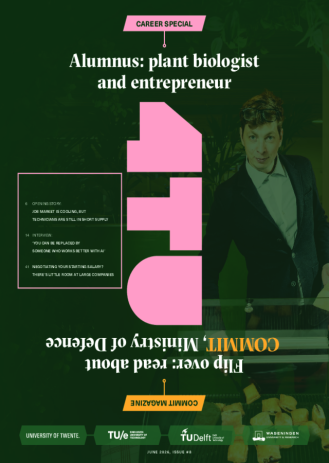



Karel Douber, a master's student in Telecommunications, does not like to answer serious questions, and his propensity for laughter can be at times highly contagious. When asked for an interview, Douber joked, `It sounds like my 15 minutes of fame. So why not?'
 |
| Karel Douber |
Since last year in September, the Czech-born Douber has been attending classes at the UT through the Erasmus Student Network (ESN) exchange program. He will return to his native city of Prague in June to finish his master's degree in Digital Signal Processes at the Czech Technical University (CTU), the oldest technical university in central Europe established nearly three centuries ago in 1707.
How did this experience affect him? `I know that life as an international student is good because of my experience as a mentor at my own university,' said Douber. The University of Twente has only five Czech students and the Saxion Hogelschool has one, making Douber one of the few representatives of his native country.
The ESN program at his university provides newcomers with a `buddy program', which couples one Czech student mentor to two international students. The orientation process is eased with introducing them to the new culture and aiding with language barriers.
He reflected, `I miss the connection with a mentor and would have liked more contact with Dutch people in the Netherlands. There are few Dutch students helping with the program at the UT, and mostly international students run the program.'
For Douber, Skype provides the daily high-tech connection to his family members in Prague: `It's quite funny because of Skype I maybe talk with my family more than when I am at home. You can see each other's faces. We wave hi and bye to each other.' He recalled a story from one of his French friends who said his mother, some years back, recollected that on a trip abroad `people had to wait in a line of 100 meters-long to use a phone with a bad connection.' He added, `This I can't imagine.'
He, however, had his doubts about talking about the era of communism in his country. `So you want to talk politics,' he laughed. `If you just closed your eyes and acted normal then you were fine, but there was something bad happening.' With the fall of the iron curtain Czechs had a false sense of security: `Everybody was happy when communism fell. But what came next was less than what we expected,' said Douber.
When Douber's father was his age, in the years of communist rule, he would travel to West Germany to earn money. With his salary, he was able to proudly purchase his first pair of blue jeans. At that time, most people were not allowed to leave the country and needed specific paperwork to cross over the border. `For example,' said Douber, `if one of your family members lived in the west then it was a problem. They were scared you would leave or bring something back with you.'
Now Prague is heralded by many as the golden city, which has valiantly survived the Second World War with most of its historical buildings left unscathed. Douber maintains faith that a sense of stability is beginning to return from, as he refers to it, `a difficult time.' He said, `I think in 10 years, it will be normal again.'
His financial package of roughly 453 Euros per month provides him with sufficient money to pay for his housing, food and monthly expenses. This money is provided by the European Union, the Chezch Technical University and the Chezch Republic government. In the approaching summer months, before returning to Prague, he has made plans to take a week-long bike tour through the Netherlands with friends. `Maybe we'll try to see more of nature than the big cities,' he said. For this curly-haired optimist, life remains open and filled with many possible adventures. And unlike many of his fellow students in the Czech Republic he commented, `I wasn't afraid to study abroad.'