

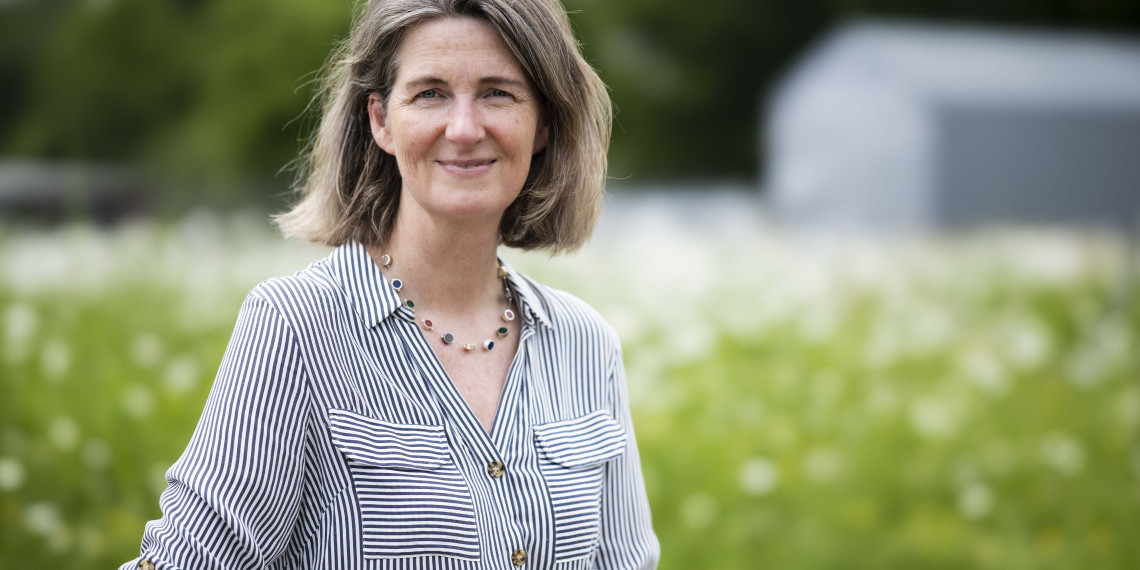
‘Look,’ says Marjolein Demmers. ‘Enschede is here.’ She stretches her arms out horizontally. ‘The Hague is at the other end. And we are in between.’ Her illustration of the geographical distance symbolises the intermediary role of Natuur & Milieu: its headquarters in Utrecht act as a bridge between for example science and politics.
Demmers took the helm of the organisation in 2017. The head office exudes sustainability, with natural colours and materials. Furniture and carpets are given a second life. The coffee is organic and fair trade, and the office spaces have names such as ‘train’ and ‘climate’. Every day, more than sixty people work towards the organisation’s aim: a sustainable future for everyone, with clean air, clean water, fertile soil and a green living environment.
four interviews
The University of Twente will award four honorary doctorates during its 65th Dies Natalis celebrations on Friday 27 November. The U-Today editorial team has interviewed all four honorary doctorate recipients and will be publishing their stories over the coming weeks. The first interview features Marjolein Demmers, Chief Executive of Natuur & Milieu.
‘Our focus is on climate and biodiversity,’ says Demmers. The organisation believes that our society and economy are exceeding the limits of what can be sustained, breaching the safe boundaries of the Earth’s natural systems. ‘But this is not necessary. And we know that. There are plenty of solutions that would allow us both to stay within those limits and to provide prosperity for society. I feel a strong drive to work towards this. I’ve been around for a while and have seen a great deal that often made me wonder whether the right things were being done. At the same time, I see how difficult it is in practice to bring all that intellectual capacity together and direct it towards the urgent, concrete challenges facing our country.’
One example she gives is the mismatch between academic research and the realities faced by policymakers. ‘The academic world is so different from a policymaker’s reality. The timescales are different, as are the language and definitions of success. Even applied research remains too far removed from practical challenges. A great deal of time is devoted to a thorough analysis of the problem. And rightly so. But in the meantime, the policymaker has long since moved on to the next societal challenge.’
‘At Natuur & Milieu, we have the freedom to be forthright and ambitious’
Demmers sees Natuur & Milieu as having an important role to play in bridging this gap. ‘We need mediators who can bring these two worlds closer together. They might be academics who develop these communication skills, or third parties who act as intermediaries. Like us. As an NGO (non-governmental organisation), we operate with considerable autonomy. We have no accountability to clients. Our ‘client’ is society. That gives us the freedom to be forthright and ambitious in proposing solutions.’
And they do so in a practical and effective way. ‘We base our work on facts and insights, preferably the latest findings from science.’ By focusing on solutions, Demmers demonstrates how scientific knowledge can be translated into societal change. For example, Natuur & Milieu researches the use of pesticides and their environmental effects. Together with other societal agencies, they advocate for policies that reduce their intensive use. At the same time, they work with one of the major supermarket chains and its regular suppliers to cut pesticide use. Experience from practice informs their policy advocacy and shows that their proposals are realistic and achievable.

Practical, results-oriented and delivering societal impact: this approach has earned her an honorary doctorate. She describes the news as ‘extremely surprising’. ‘I feel very honoured. I’m very much focused on tangible results, rather than on status or titles. This distinction feels like a major recognition of my work and that of Natuur & Milieu, and I’m genuinely grateful for it. Particularly because a considerable part of my work takes place behind the scenes. It’s nice to see it recognised.’
A wonderful new step
She does not know exactly how she will make use of the honorary doctorate. ‘When I received the good news, I called my sister. She is a professor in Utrecht and immediately said, ‘This really is a great honour.’ But I haven’t been very active in the academic world. I gained a great deal of knowledge and management experience in the business sector. I’ve now spent several years as director of an NGO, and science has found me.’ She sees it as a wonderful new step. Together with the honorary supervisors, she is exploring how to give the doctorate meaningful substance. ‘We’re having some very enjoyable conversations about it.’
'No one consciously wants to destroy the world'
There are plenty of opportunities for collaboration. To move towards a sustainable society, Demmers believes it is important to understand behaviour. ‘We as a society have been heavily conditioned and trapped in an unsustainable system.’ She gives the example of how readily we buy a new phone even if only the camera is broken, when repair ought to be the most attractive option.
Demmers believes that much of this has to do with the human brain and psychology. ‘A great deal happens automatically. But the easy choice, the one that feels normal to us, is often the choice that causes environmental pollution. We can organise things differently, so that the reverse is true. That requires different policies and a different range of products: products that are easy to repair, for example; a ban on PFAS; and a tax on kerosene, among other measures. At the same time, I firmly believe, deep down, that everyone wants what is best for the world and that people have the best intentions for one another. No one consciously wants to destroy the world.’

Understanding behaviour and stopping harmful practices requires an integrated approach. Demmers recognises this at the University of Twente (UT). Last July, she visited the campus. ‘What resonates with me about Twente is its search for an integrated perspective. Technology does not exist in isolation. It is always considered in context: what is happening in society, how does it function, and what is needed? That knowledge is at least as important as technology itself.’
She sees the fact that this expertise is part of the university as a major asset. ‘It brings the social sciences and engineering together. By bringing them together at one university and on one campus, and explicitly linking them within degree programmes, you not only conduct more relevant research, you also educate people whose skills are better suited to the challenges of our time. Because those challenges,’ she explains, ‘are themselves interconnected.’
To pioneer
There was no such broad approach when she graduated in Industrial Design Engineering from Delft University of Technology in 1993. ‘It was a different era.’ Demmers therefore pioneered the practice of taking additional courses outside her curriculum at another institution. ‘But finding the right course was quite a challenge. I excelled in science and mathematics, but I was also creative. I visited many open days, including art schools, and mathematics and physics.’ In the end, she chose industrial design in Delft. ‘It was very technical. We studied subjects such as mechanical engineering, but also creative disciplines such as drawing and design.’ It proved to be an ideal match. ‘I felt at home there. I liked the challenge of developing a single design solution to a problem that brought together so many different aspects.’

She regards the degree as one of the most ‘integrative workouts for the brain’, and one from which she still benefits greatly. ‘You learn to analyse a problem from many different angles. It gives both your creative and analytical brain an enormous workout.’
Demmers never ultimately became a product designer. ‘I was very critical of my own creations.’ She also recognised the downside: continually bringing new products to market that have a substantial environmental impact. That did not feel right. A lecture by two entrepreneurs, the director of The Body Shop and the director of PRé Consultants, marked an important turning point. ‘Their account of responsible and environmentally friendly business, ecodesign and product life-cycle assessment really appealed to me.’ Inspired, she decided to undertake an internship at one company and complete her graduation project at the other.
'I think I was the first graduate in ecodesign'
Driven by her interest in nature and the environment, she took individual courses at the University of Amsterdam. ‘I needed some additional grounding in environmental science. We didn’t cover that in Delft. On my own initiative, I took several modules at the University of Amsterdam, which I was also able to add to my list of courses.’ She continues: ‘I think I was the first graduate in ecodesign, a field that acquired its own academic group shortly after I graduated.’
Her career began in the business sector. She first worked at PRé Consultants, followed by the Royal Melbourne Institute of Technology (Centre for Design), McKinsey & Company, Essent, DHV, Royal Haskoning and De Groene Zaak. A consistent thread throughout has been a strong focus on the environment and sustainability. Now that she works for an NGO, knowing ‘the other side’ is an advantage. ‘We pursue ideals, and those ideals remain firmly in place. But if you work purely from ideals, it is difficult to put yourself in the position of those who need to bring about change. In fact, there is a risk that you will end up further apart. Some understanding of the realities of practice—of what people and organisations are capable of—helps you build bridges.’
‘I’m proud of our access to political decision-makers’
She says she finds it ‘enormously enjoyable’ to lead a team. ‘That means choosing a direction together, giving people room to work, and keeping one another sharp. Ultimately, it is my responsibility to ensure that we work productively and continue to secure funding for what we want to do.’ She is proud of the organisation’s access to political decision-makers. ‘It may seem a small achievement to me, but we have established good channels in The Hague with civil servants, policymakers and ministers. That reflects a recognition that what we contribute is relevant. I was meeting with the minister just this morning. I’m pleased that we are able to engage with one another so effectively.’
Another related achievement of which she is proud is the analysis by Vrij Nederland. ‘Once every seven years, they investigate who has the greatest influence in the political arena in The Hague. I’m honoured that Natuur & Milieu ranks sixth, especially as a relatively small NGO among the major trade associations.’

The big question is whether there is enough time to address the sustainability challenge. ‘Climate change won’t wait. Eventually, reality will force the issue. That may not sound particularly optimistic, but many technological solutions already exist, and I also believe that social norms can sometimes change very quickly.’ She cites the debate around Zwarte Piet, smoking in public and wearing seat belts in cars. ‘Or think of plastic carrier bags in shops, and plastic coffee stirrers and straws. We no longer regard those as normal. They are small examples, but they show that policy can bring about change. And look at last summer: the forest fires, the tornado in France. I hope there will be a socio-psychological shift in how we collectively view these things—that we no longer want to contribute to these negative trends and instead seek happiness in activities other than material consumption. For example, wasting resources or frequently flying to distant holiday destinations could become less socially acceptable. The research community, too, is working tirelessly to develop solutions for organising the world differently. That gives me the determination to keep going. I am convinced that a sustainable society, in balance with the planet’s natural systems, is possible.’