

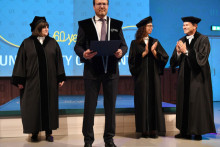
There is no fixed set of rules for awarding an honorary doctorate. Each case is considered individually, and every university has its own criteria. The distinction is generally awarded to people who have made exceptional contributions to science or society. They are often academics, but writers, athletes, entrepreneurs, politicians, artists, and members of royal families have also received this highest academic honour. Universities use honorary doctorates to recognise the achievements of laureates, while also seeing them as an opportunity to build ties with prominent figures. Honorary doctorate recipients are ambassadors for life, UT writes on its website. In short, the distinction creates a lasting connection.
Doctor honoris causa
The official title is doctor honoris causa (abbreviated to dr.h.c.). This is not quite the same as the regular doctoral title (dr.), awarded to PhD candidates who successfully defend their dissertations. Traditionally, candidates are nominated by the university’s professors, who act as honorary supervisors. The Doctorate Board, consisting of the Rector and the Deans, ultimately decides who receives an honorary doctorate. The prospective recipient is then approached informally. It is important that they are able to attend the ceremony. At UT, honorary doctorates are awarded every five years during the Dies Natalis, the university’s birthday celebration in November.
The list of UT honorary doctorate recipients is long and varied, although it is dominated by renowned academics. Other notable names include former State Secretary Neelie Kroes, Prince Constantijn, and Jamie Hyneman and Adam Savage of MythBusters, the hosts of the popular science programme of the same name on Discovery Channel. As far as is known, an honorary doctorate from UT has been refused only once. Peter Benenson, the founder of Amnesty International, declined the honorary doctorate offered by THT (UT’s predecessor). He felt it was not right to honour individuals from Amnesty International. In his view, the organisation as a whole could be honoured instead.
Under fire
At other universities, the awarding of honorary doctorates has often caused controversy. Utrecht University came under fire after awarding one to Winnie Mandela, Nelson Mandela’s wife at the time. The honorary doctorate awarded to entrepreneur Albert Heijn by Nyenrode Business University was also not well received. In 2016, Egbert Torenbeek, professor emeritus at Delft University of Technology, returned his Russian honorary doctorate in protest against President Putin’s undemocratic policies and the downing of flight MH17.
There appears to be no such controversy at UT this year. The honorary doctorates are going to UT alumnus Martin van den Brink, Marjolein Demmers of Natuur & Milieu, Professor Molly Stevens of the University of Oxford, and economist Klaus Deininger. The official ceremony will take place during the Dies Natalis on 27 November.
This article was previously published in the special edition on honorary doctorates.