


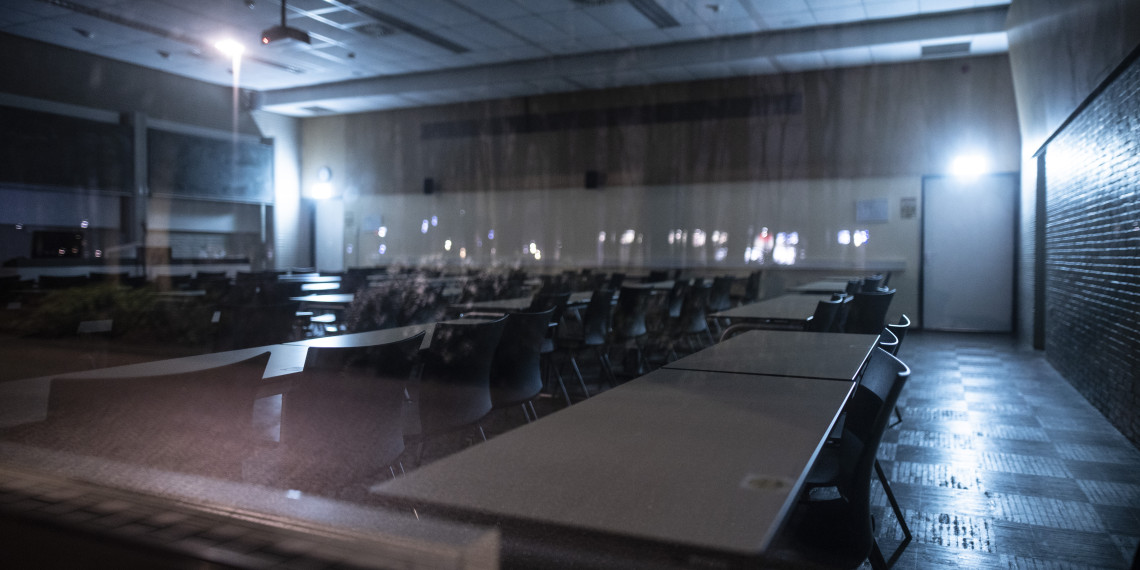
‘I once walked into an exam hall and thought: shit, this must be the wrong room. These can’t be my students...’
After blinking twice, associate professor Anne-Johan Annema realised they were in fact his electrical engineering students. He had simply never seen a substantial number of them in his lectures and tutorials.
Mechanical engineering teacher Jurnan Schilder can relate when it comes to his course Dynamics 2. ‘I had 200 students attending the lectures, 50 at the tutorials, and I ended up marking 400 exams.’
Downward trend?
An exodus from the lecture halls? Those are not the words Rector Tom Veldkamp used when speaking to the University Council. Rather, it was a side remark in a broader discussion about the pressure on student engagement. Still, according to the rector, the image of increasingly empty lecture halls does not fit the Twente Educational Model.
According to Annema, there is definitely a ‘clear downward trend in attendance’. ‘Especially since the Covid-19 pandemic,’ he observes. ‘I’ve also noticed that the type of questions students ask has changed. Quite regularly, I’m asked what will be on the exam. If you attend my lectures only to scrape a pass mark, then you’re in the wrong place. Ultimately, the only person you’re disadvantaging is yourself. I expect more from students, and they may expect more from me.’
Jurnan Schilder is more cautious and hesitates to describe it as a trend. ‘In a way, it’s only logical. During the first week of TIME (Twente’s Introduction to Mechanical Engineering, ed.), the lecture halls were fuller than in previous years. In that first week everything is new, everyone is enthusiastic, and students feel it is important to attend. After that, attendance tends to drop.’
Schilder especially notices this during tutorials. ‘And I understand that too. Students work more independently and can ask questions along the way. If you have mastered the material, a lot of that can also be done at home.’


On the left: Anne-Johan Annema, on the right: Jurnan Schilder.
‘Students are becoming more selective’
Associate professor Pieter Roos of civil engineering sees a similar pattern. ‘I don’t experience declining attendance at my lectures, but I do notice that students have become more selective about participating in educational activities such as tutorials.’ Like Annema, Roos sees changes that date back to the pandemic. ‘Students were forced to function more independently and in greater isolation during that period. Yet interaction with lecturers and fellow students during tutorials has proven added value, both academically and socially.’
His colleague Bas Borsje, the current UT Teacher of the Year, does not see emptier lecture halls. ‘But perhaps that is because students taking Fluid Mechanics 2 know that attending lectures makes the material much easier to understand than studying it on your own.’
Social pressure and expectation management
Lecturer Anne Leferink says she has no complaints about empty seats in the Technical Medicine programme. ‘I see very strong attendance among first-year students. I’m extremely positive about this cohort. There is more social cohesion and interaction than in recent years.’ According to Leferink, peer effects play an important role. ‘If you see your fellow students skipping lectures, there is naturally less social pressure on you to attend yourself.’
She also points to the importance of expectation management. ‘None of my lectures are compulsory. Students simply want to be there. If lectures are engaging, interesting, educational, and interactive, students feel they gain something from them. Sometimes they skip courses because they consider them boring or not particularly useful. Just this week, I heard a student complain about a two-hour lecture on health insurance and how to choose a policy as a student. After two lectures like that, students will stay at home.’


Pieter Roos, Anne Leferink and Bas Borsje.
Competition
And yet, no matter how well designed and engaging a lecture may be, several factors influence attendance. Schilder also teaches in Amsterdam, to students enrolled in the joint VU-UT Mechanical Engineering programme. ‘That means I also see the situation at Vrije Universiteit Amsterdam. Even more than here, many students there continue to live at home. Being physically further away from campus creates an extra barrier. Students become more selective about whether a single lecture is worth an hour of travel, instead of a fifteen-minute bike ride.’
Distance is not the only factor. Time matters too, the lecturers say. ‘My impression is that students increasingly need to work in order to finance their studies and living expenses,’ says Leferink. ‘Labour participation among young people is high. I sometimes receive requests from students who need to switch tutorial groups because of work commitments, but they usually sort it out themselves.’
According to Schilder, the key issue is competition. ‘Our education has to compete with part-time jobs, that Netflix series, and countless other activities. That immediately raises questions about our own role as lecturers and about the role of the campus. If you want to say something meaningful about this, you first need to understand who your competitors are. It reminds me of something a former director of the Efteling once told me: the Efteling does not really compete with other theme parks, but with sleeping in or spending the morning doing jobs around the house.’
‘Learning should be an adventure’
There is no easy solution. ‘Mandatory attendance is not a learning objective,’ Schilder says dryly. As both Borsje and Leferink argue, if a lecture is engaging and worthwhile, that is already half the battle. Annema agrees. ‘Learning should be an adventure. It is not about memorising facts or ticking boxes. As a student, you are not here to imitate or parrot information. As a lecturer, you are not a memory trainer. In the end, it is about wanting to understand and wanting to learn.’
Annema goes to great lengths to make his teaching as attractive as possible. He uses a ‘1 versus 100’ quiz during lectures and develops web apps that incorporate game elements. ‘My teaching revolves around serious fun. I always try to inspire, motivate, challenge, and sometimes even slightly irritate students. Serious and fun, with a purpose. I’m pleased when that works. My lectures contain virtually no slides, so there is nothing to send around afterwards. I want students to develop that capacity for learning themselves, to discover things and fit the pieces of the puzzle together. In the end, they are not there for me, but for themselves.’
Making lectures ever more ‘fun’ also has its limits, Schilder says. ‘We need to address a more fundamental question: how much time does a student actually want to spend on their studies? We calculate 42 hours per week for a fulltime programme, but the majority of students in our engineering programmes do not study at a nominal pace. Why not offer a realistic four-year bachelor’s route for students who want one? Perhaps we need to take a closer look at where the real demand lies.’