

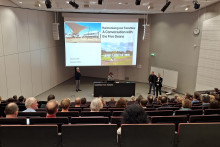
BMS dean Tanya Bondarouk opened with a statement reiterating why harmonisation is necessary: clearer and more consistent working processes across all faculties, greater clarity about who is responsible for what, more resilient departments, and shared leadership. ‘What's not to like about that?’ she asked. Uncertainty surrounding government policy and the rise of AI were also cited later as reasons.
A framework, not a one-size-fits-all approach
The four deans (ET dean Bart Koopman was absent) divided the sixteen questions into two categories: uncertainties about the organisational structure and doubts about the division of roles and responsibilities.
One question was whether differences between faculties would be taken into account. Boudewijn Haverkort of EEMCS confirmed that they would, stressing that this was not a one-size-fits-all solution. According to him, harmonisation primarily serves as a framework within which faculties can reorganise themselves. Jeroen Cornelissen of TNW said there would still be room for couleur locale. Freek van der Meer noted that differences in culture and working practices between faculties can slow down processes.
Asked whether support staff would be moved between faculties, Haverkort gave an ambiguous answer: ‘Support staff will not be redistributed across the faculties. Unless there is a good reason to do so.’
Difficult to measure
There were few strong reactions from the audience. However, several attendees asked for a document explaining why harmonisation was necessary in the first place and how its success would be measured using performance indicators.
Cornelissen responded that documents outlining this already exist. According to him, restructuring is not an end in itself, and its success is difficult to measure. This is striking, given that UT's strategic plan states that the university intends to use reliable data to monitor whether harmonisation is on track.
He emphasised the importance of input from the UT community and encouraged people to engage in dialogue: ‘Come to us with your questions and input, because if we don't know what's on your mind, we can't do anything about it.’
Any questions submitted via the livestream were not addressed.