

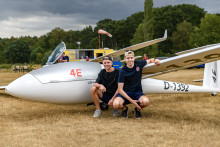
Gliding was not entirely new to the Business Administration master’s student. A love of flying runs in the family. ‘My grandfather was a KLM pilot during his working life. There were already photos of my grandfather and father in a glider, and of my father and me in a Maxi-Cosi in a glider. Recently, I took my grandfather on a flight and we completed the triptych.’

The triptych: Father with grandfather, father with Chris, Chris with grandfather.
Club life
He spends time on his hobby every week. ‘It’s not just about flying, though. You also help others get airborne by operating the winch and transporting equipment to and from the airfield. You’re alone or with one other person in the cockpit, but before you get into the air, you always depend on the help of fellow members.’
The Twentsche Zweefvlieg Club is a civilian club. There are hardly any students among its members. And yet, according to Van den Heuvel, the membership fee is quite reasonable. ‘Depending on your age, you pay no more than about 1,300 euros a year. That includes everything: training, assistance with flying, insurance, social activities, and use of an entire fleet of aircraft. You do have to contribute in return, but that’s part of club life.’
He also greatly appreciates being in contact with people who are not students. ‘The campus is a bit of a bubble. At this club, you work alongside people of all ages and from all kinds of backgrounds.’
Constant adjustments
If he loves flying so much, why not train to become a pilot? ‘I considered it, but I find flying a powered aircraft less exciting. You take off, set it to a fixed speed, and then there’s actually not that much left for you to do. In a glider, you’re constantly making adjustments, monitoring the weather, and thinking about your course.’
Flying a glider itself is not the hardest part, according to Van den Heuvel. ‘If you push the nose down, you gain speed, but you also descend. Pull the nose up and you climb again, but you also lose speed. You’re constantly looking at how many metres you’re climbing or descending in the air you’re flying through. Basically, you’re falling very slowly.’
A strong stomach
He explains that a glider depends on rising currents of air, known as thermals. ‘You have to pay close attention to the weather. For example, you look for fluffy cumulus clouds, because they show you where the warmer, rising air is. Once you fly into one of those pockets of air, you can start circling and gain altitude. You need a strong stomach for that, because you can spend fifteen minutes banking to the left or right.’ That is how he recently completed his longest flight ever: ‘All the way to Drachten and back. Magical.’
But the student is not always that lucky. ‘If the weather is against you and there aren’t enough rising air currents, you occasionally have to make an emergency landing in a field. First you check whether the field is long enough and whether there are any cows in it, and then you just bring the glider down. Farmers aren’t always happy about that, but there’s no other option.’
Safety
Van den Heuvel is not easily frightened, but he is constantly thinking about safety. ‘Not much can go wrong if you pay attention and go through all the checks. All the accidents in recent years have been the result of a series of human errors or negligence.’ It is therefore no surprise that he sits on the club’s safety committee.
He dreams of one day flying in an Alpine country. ‘Between the mountains, the thermals are completely different again. And of course, the views are phenomenal.’