

Let’s get straight to the point: what do you think of the reports about social safety issues at the EEMCS faculty?
‘Obviously, I will first take a close look at this together with my colleagues on the Executive Board to see how we should approach it. I also assume that everyone who has a role in this is competent and motivated to resolve it. There isn’t much more I can say about it at this point. Social safety issues have been around for some time and, unfortunately, occur at all universities. The discussion we need to have about this is important, quite apart from the individual cases underlying it. How do we want to treat each other at universities and in situations where there is an imbalance of power? How do we want to interact when the system is under pressure? It seems fairly evident to me that having these discussions is important for the university system.’
Can cases like these be prevented at all?
‘I don’t know enough about this specific case to say. But I would like to turn the question around. It’s better when issues become known, than that they remain hidden. It means we can look at the processes together and see what we can learn from them.’
What motivated you to live and work in Twente? The green campus is of course quite different from VU Amsterdam’s.
‘UT is a wonderful university. It really is Twente’s time now. If you look at government policy on talent and the economy, and at the challenges of our time, and then put those alongside UT’s strategic plan, they seem made for each other. As a university with ‘high tech human touch’, we can now work on the major questions and answers relating to four big issues: greening, ageing, geopolitical challenges, and generative AI. We won’t solve these without technological innovation. But we do need to solve them in a way that preserves our way of life in an open society. And that combination of technology and society and economics is something traditional universities don’t have, but UT does.
Personally, I’m full of energy to work on these kinds of major challenges and I want to be part of that. In the past, I was always affiliated with universities that had a particular mission for their part of the world, such as in Singapore and Copenhagen. And the idea that UT would be too small for me? We really need to stop thinking of ourselves as the underdog.’
Are you going to live here?
‘I haven’t found a home yet, but I stand by what I said: I’m going to live on campus. For now, I’m staying at the U Parkhotel.’
What major challenges lie ahead for you?
‘For me personally, it is about understanding the organisation as well as possible. That is always a challenge, especially when you’re new. In the first few weeks, I will have as many conversations as possible and get to know people and their ambitions. Another challenge is making sure I don’t commit to things too quickly, but take the time to consult my fellow board members Machteld and Tom.’
What are you looking forward to?
‘I love seeing the things that are invented here on campus. I may not be an engineer myself, but I have a passion for technological innovation and the enthusiasm that comes with it. My first jobs were at Siemens, and that has stayed with me ever since.’
How familiar were you with University of Twente already?
‘There is of course the collaboration with VU Amsterdam, which I was involved in as well. In that capacity, I have visited the campus several times before, and met my fellow Executive Board members. I was already familiar with the wider region, at least if we assume that the region doesn’t end at the border. I lived in Münster, studied and obtained my PhD there, and met my partner there. I also spent time in Enschede during those years. So this region was part of my formative years.’
(Story continues below photo.)
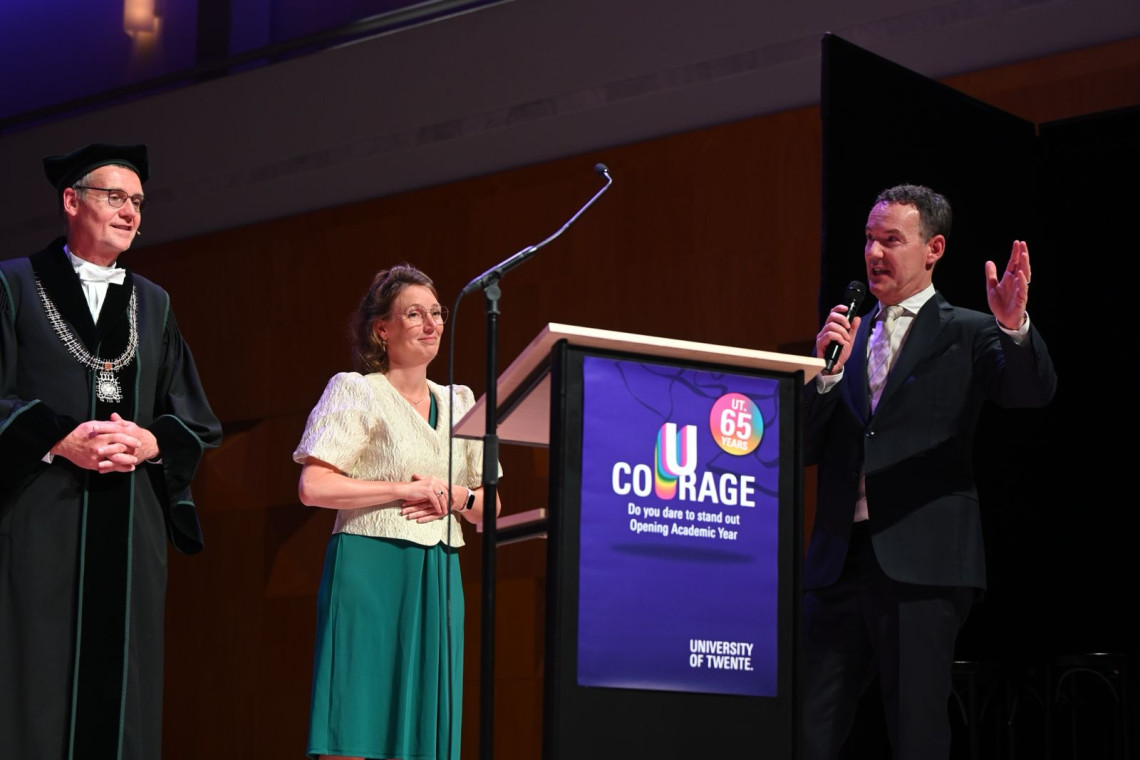
Gregor Halff at UT's OAY. Photo by: Eric Brinkhorst.
What kind of Executive Board president are you?
‘I think it’s important that we are ambitious. As a university, we have a special mission, and we need to pursue and communicate it with confidence. I will do that consistently. I think we can afford to be a little less modest about what we do here. Secondly, the quality of what we do lies in asking good, scientific questions. And everyone must have the freedom to ask questions. We can only achieve that freedom for everyone if we can hold together as a UT community. And sometimes things need repairing. I will work to make that happen.’
How do you keep a community together?
‘It comes down to two things. First, explicitly talking about our shared values. That is something I still need to discover at UT: what do we all believe in? And secondly, creating opportunities for dialogue. That can be informal or formal, or bilateral, but facilitating dialogue is part of it.’
What do you value within the academic community?
‘I believe there is a great deal of strength in other people. Part of my role is to bring out that strength, get people enthusiastic about using it, and show them how they can harness it themselves. On the other hand, I have little patience for defeatism. There is always a solution, especially at a university with so many smart people.’
Turning to your background, where did you grow up?
‘I grew up in India, Costa Rica, New York, Germany, the Netherlands, Pakistan, and Trinidad. My mother was an anthropologist and my father a diplomat. I have a younger brother who works for the United Nations in New York and who is very dear to me. It wasn’t until my mother became terminally ill in 2022 that I settled permanently in the Netherlands.
So yes, I grew up in an enormously privileged environment. And I believe you must give something back for that. To translate that privilege into responsibility by doing something for others.
Another thing I learnt growing up is that I’m grateful to my parents for always sending me to local schools. I was often in the minority there. That taught me to pay close attention to the people around me. Perhaps he or she knows something that I don’t? And one thing my international childhood taught me is that if you take an interest in other people and your surroundings, you can be happy anywhere.’
You were a student in Münster. What kind of student were you?
‘A bit of a boring one, I think. I completed my PhD at a young age, at a time when it was difficult to find a job. As a result, I became overly diligent about getting very good grades. So yes, I was boring. I also weighed more than a hundred kilos. And no, I’m not showing you any photos of that. It wasn’t a particularly active life, anyway. I also came out during that period. That was different then from how it is now, especially in Germany. Coming out is new territory for any student and can still be difficult for students today. You do end up hiding yourself a little. I think I only became a more interesting person to talk to after my studies.’
What would you like to tell today’s students as they start a new academic year?
‘Freedom and curiosity. There is no better community than a university in which to freely pursue your curiosity. And ask questions, ask for help. You are never alone, there are always people there to help you.’
(Story continues below photo)
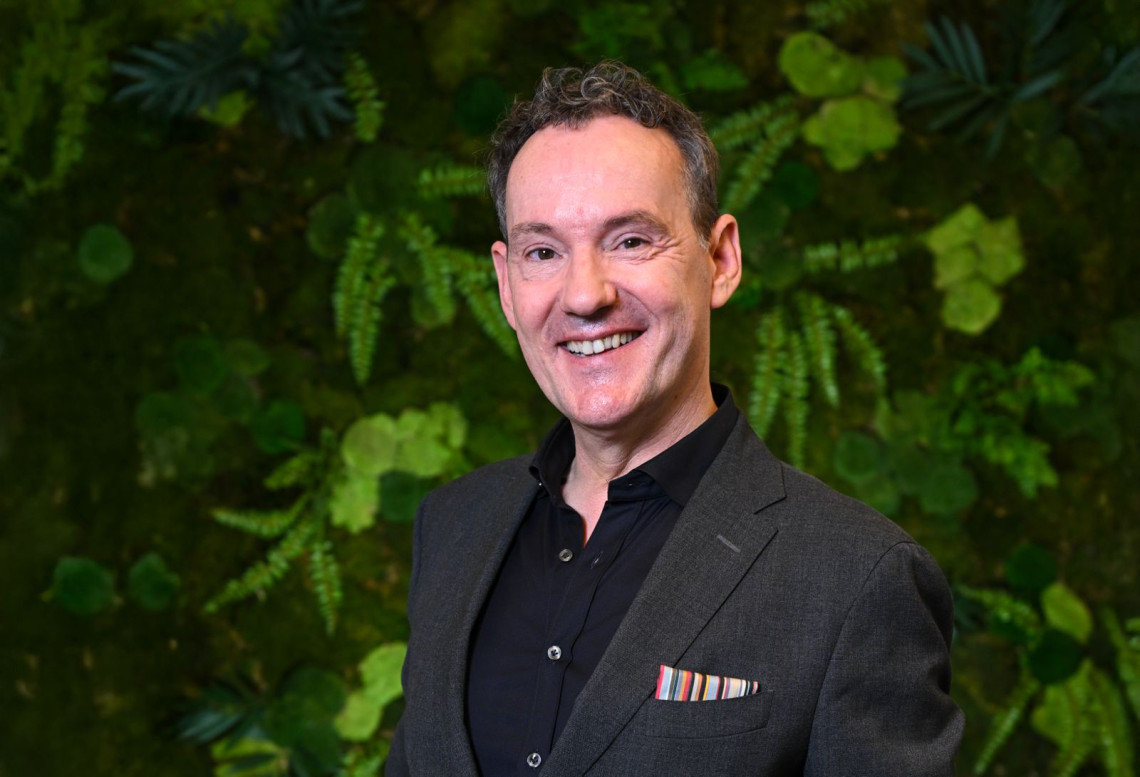
Photo by: Eric Brinkhorst.
What do you do outside working hours?
‘Because of my international background, I have a lot of friends all over the world and I enjoy meeting up with them. I probably won’t have much time for that for the time being, though. The next few months will mainly involve a lot of work. It is my responsibility to get to know the organisation as quickly and thoroughly as possible.’
Finally, is there a question you would like to answer yourself?
‘I think that, with my background as a social scientist, I’m often going to be asked: ‘Do you actually understand technology?’ So here’s my answer: I don’t understand every new technology, and I’ll need colleagues to help me with that. But I am drawn to the impact of technological innovation and what it means for society. I understand very well the task we face when it comes to technological innovation. From my international perspective, I see that a great deal of technology comes from countries that are not the kind of societies we want to be. As a university, we therefore have a responsibility to ensure that technology is developed in a way that keeps our society open and safe. Because there is immense technological competition from societies that are not open. That is a special responsibility for a university like ours.’