


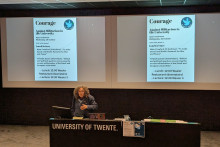
The conference, which was followed by a workshop session, was titled ‘Courage’. The organisers did not choose that title by chance. It is also the theme of UT’s anniversary year, as outlined in this article. The UT Peace Center wanted to offer its own interpretation of ‘courage’.
For this group of pacifist students and staff, courage means speaking out against the militarisation of universities. They fear that universities are coming under increasing pressure to align themselves with major investments in defence. The group previously claimed the Educafé as a venue for meetings on the subject. Their efforts were unsuccessful, however, as the space ultimately became a study area.
On Wednesday afternoon, two external speakers were invited to discuss militarization in universities: political scientist Neta Crawford of the University of St Andrews and philosopher Yolande Jansen of the University of Amsterdam. Around sixty people attended the event in Waaier 3.
‘Prepare for peace’
Crawford began by describing what she called a ‘mobilisation on a planetary scale’. ‘Within NATO, there are two major concerns: a potential attack by Russia and China’s threat towards Taiwan. In response, all member states are increasing their military spending. Their standard response is to strike deep into enemy territory.’
The dominant doctrine, she argued, is deterrence. ‘If you want peace, prepare for war,’ as Crawford put it. ‘But you can also frame it differently: if you want peace, prepare for peace.’
According to Crawford, neither Russia nor China currently has the intention or the capability to engage in a large-scale conflict. Referring to history, she underscored the importance of peace research. ‘Many of these research centres emerged during the twentieth century. In the 1980s, researchers studied the potential effects of a nuclear winter. When Reagan and Gorbachev learned about those findings, they drew their own conclusions about reducing their nuclear arsenals.’ In her view, this demonstrates the significance of peace research. ‘Independent of any ministry, peace researchers changed the world.’
Universities’ responsibilities
Jansen then explored the role of universities themselves. Militarisation is putting increasing pressure on the sector, she argued. ‘Take, for example, the AWTI report, which calls for the entire knowledge ecosystem to be mobilised for defence. In addition, there are plans to make dual-use applications easier to accommodate within the European Horizon programme from 2028 onwards. At the same time, lobbying by the arms industry in Brussels has increased considerably.’
The result, she said, is that shifts in research funding and priorities are raising new questions about the growing intertwining of civilian and military applications. ‘As funding and research agendas change, the question of how closely civilian and military applications are intertwined becomes increasingly important,’ said Jansen.
Yet universities themselves are barely engaging in serious discussion about the possible military influence on research and education, she argued. ‘These are precisely the ethical and political debates we should be having.’
Jansen therefore urged universities to devote much more attention to the issue. In her view, institutions are lagging behind developments. ‘First of all, we need to build more knowledge, because that is currently lacking. Then we must have the right critical conversations with one another about our own responsibilities. As a university, you do have that responsibility.’