

What exactly was your PhD research about?
‘The field I work in is called Health Technology Assessment. We assess the societal value and cost-effectiveness of medical innovations. For my PhD research, I evaluated the value of PET scans compared with MRI and CT scans, including for bowel cancer that has spread to the liver. A scan itself doesn't make a patient better, but the treatment a doctor recommends based on that information might.
But because treatments aren't free, we have to weigh up whether a treatment is worthwhile if it barely improves a patient's quality of life or chances of survival. Capacity constraints and staff shortages also play a role: an operating theatre can only be used for one patient at a time. Who gets priority? We all want the best possible patient care, based on solid evidence that medicines and treatments are effective.’
But healthcare is about more than efficiency. Are doctors happy with this kind of research?
‘They're not happy if, after a long and expensive series of clinical trials, you come along afterwards like a gatekeeper and reject an innovation. But we also carry out this kind of research earlier in the innovation process, before a large-scale patient study has even been set up. That way, doctors can receive sound advice in advance about where in the care pathway, and for which patients, an innovation could offer the greatest added value.
Fortunately, doctors always put their own patients first, but they're also aware of staff shortages and budget constraints. Scarcity inevitably means that some care is displaced by other care. Ultimately, we share the same goal: providing the best possible care for patients in a way that can be justified to society.’
And then you became a patient yourself... What happened?
‘At some point, I felt a small lump. I went to my GP, who took immediate action. Literally overnight, you become a cancer patient yourself. Fortunately, testicular cancer is highly treatable. I had surgery within a week and was back at work within a month. So my PhD research was barely delayed, and most of my colleagues didn't even notice.’
Did it change your perspective on healthcare and your own research?
‘Personally, it hasn't changed me much. I'm still the same Sietse. Everything happened very quickly, and because of my field of study, I already had some experience with healthcare, so I knew how good the healthcare system is in the Netherlands. Besides, my type of cancer was highly treatable. That gave me confidence. Of course, the weeks after surgery were nerve-racking, because you have to return for a scan to check whether the cancer has spread.
Fortunately, that wasn't the case for me, and I've now been cancer-free for four years. I was lucky.
At the same time, I discovered just how complex healthcare really is. There are dozens of predictive factors for every specific variant of a condition. As a researcher, that makes sense to you. But as a patient, it can sometimes be almost impossible to follow.
More generally, perhaps this experience has made it easier for me to put things into perspective: how important is everything, really? As long as you're healthy.’
During your PhD defence ceremony, you donated money to AYA, a foundation for young adults with cancer. How did that come about?
‘It's customary for guests and family members to give you presents at your ceremony. You can indicate beforehand what you'd like. Although my own experience ended relatively well, I saw just how much impact a cancer diagnosis can have on people my age. The AYA Fund specifically supports people at this stage of their lives, so I asked my guests to donate their contributions to AYA instead. We also agreed that the final amount would only be revealed during the ceremony, and that our target was one thousand euros.
The amount raised was kept a secret from me throughout. My paranymph eventually announced that we'd raised 2,295 euros.’
How do you see the future?
‘I'm currently working as a postdoctoral researcher at Radboudumc. I'm focusing on the issue of healthcare capacity, because there are already shortages, and they're only going to get worse. So what do we do with operating theatres when we have far fewer staff in the future? How do you decide which patient gets surgery and when? We need to move towards a system in which patients who genuinely need to be in hospital receive treatment there, while others are helped in alternative ways.
There's no avoiding it, so we'd better start thinking about it now.’

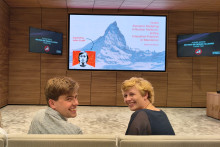
Van Mossel and Duyvendak during the announcement of the amount raised.
Sietse van Mossel
Studied Technical Medicine and Industrial Engineering and Management at UT from 2015 to 2022. During his studies, he served on the board of the Student Union and was active in the Ludica student tennis association. From 2022 to 2026, he worked at UT as a PhD candidate in Health Technology Assessment. Van Mossel now works at Radboud University Medical Center.