

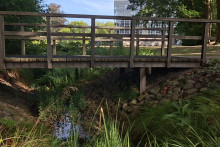
From his office, Booij looks out over the light-brown grass and the cooling pond in front of the Horst building. ‘Why do they cut the grass so short when it’s this dry?’ he wonders aloud. He admits he has little insight into UT’s grounds management policy. He knows much more about what is needed to prevent Twente from drying out completely. ‘It is clear that we are seeing more and more extremes: extremely dry summers, wet autumns and winters. At one moment there is too little water, at another too much. As a society, we need to prepare for that.’
Hydrology
At UT, water management is embedded in the Civil Engineering programme at the ET faculty. The bachelor’s programme provides a broad foundation in water management, while the master’s focuses on hydrological modelling. As an associate professor, Booij divides his time between teaching and hydrological research. ‘Hydrology deals with the water cycle, from evaporation and precipitation to water flowing back to the sea. I mainly focus on what happens on land: river catchments and how they collect and distribute water.’
Drawing on his expertise, Booij regularly advises organisations including the Vechtstromen Water Authority and Rijkswaterstaat on policy. The nature of that work has changed somewhat. ‘We used to mainly study water supply issues in faraway countries, but because of the current situation, these issues are getting closer and closer to home.’
He also works with the BMS faculty on the governance side of water management and with ITC on satellite data.
For Booij, there is something bittersweet about seeing earlier predictions and estimates now playing out before the eyes of the entire country. ‘Research by a UT PhD candidate showed fifteen years ago that climate change would cause meltwater in the Rhine to disappear earlier in the year, potentially resulting in extremely low water levels for prolonged periods. Reality is catching up with the climate scenarios.’
Cross-border cooperation
In addition to the local water authority and the Cross-Border Platform for Regional Water Management (GPRW) in Gildehaus, the government of the German state of Lower Saxony is among those drawing on UT’s expertise. As a knowledge partner, the university is involved in the cross-border DIWA project, which focuses on drought in the catchments of rivers including the Vecht, Oude IJssel and Berkel.
Two UT PhD candidates, one of whom is supervised by Booij, are conducting research in the border region that directly influences interregional water policy. One is investigating how climate change specifically affects drought and water levels throughout the border region, including Twente. The other is studying drought resilience from a governance and societal perspective. Their research results in recommendations on how the Netherlands and Germany can improve cooperation and data sharing.
‘Some things we consider perfectly normal here are innovative in Germany. Take our so-called water allocation hierarchy, for example. In the Netherlands, we have established a hierarchy to determine who has the greatest need for water and therefore gets priority during droughts. Dykes and nature come first. They are followed by energy and drinking water supplies, and then, for example, greenhouse horticulture and agriculture.’
For years, Dutch policy was to discharge excess water into the sea as quickly as possible. ‘To do that, a network of deep ditches was created to drain farmland as quickly as possible. That makes sense, because if the land is too waterlogged, you cannot use large agricultural machinery on it. But now that summers are becoming increasingly dry, food production is at risk, so perhaps we need to reconsider that approach. Or people need to make more conscious choices.’
Story continues below image.
 A pair of jeans
In any case, Booij believes society needs to become more conscious of its water use. ‘Average water consumption in the Netherlands is around 120 litres per person per day. That includes obvious things such as showering and flushing the toilet. But,’ he says, pointing to his trousers, ‘do you know how much water it takes to produce a pair of jeans? They are usually produced in countries where water is already scarce. Research by UT has shown that this indirect water consumption comes on top of those 120 litres. The Netherlands used to have a campaign saying “use water wisely”. We could easily bring that one back.’
One possible way to reduce the extremes, according to Booij, is to slow down the rate at which water drains away by keeping water levels in ditches higher for longer in spring. Farmers would notice the effects of that as well. ‘They would have to use lighter machinery on their land. That requires alternative approaches to farming.’
Another possibility is to use water from the IJsselmeer. ‘The Afsluitdijk was built to prevent flooding and create new agricultural land. Nowadays, its function has almost been reversed: the IJsselmeer can serve as a water reservoir and provide additional water in times of scarcity.’
He also points to the amount of water needed to sustain intensive livestock farming. ‘Livestock needs drinking water, but the feed for the animals also has to be grown and therefore irrigated, for example.’ He would not go as far as banning people from eating meat. ‘But you can teach people to be more conscious about their food and, in particular, what they eat.’
Booij also cites Belgian building regulations as a good example: ‘People there are required to collect a certain volume of water on their own property, depending on the size of their roof, so that they need less mains water for their everyday water needs.’
New reality
Although he is concerned about the climate and persistent drought, Booij sees no reason to panic. ‘It is a new reality. We need to adapt to it and be resilient.’ For a start, he would advise UT to cut the grass a little less short. ‘That way, it retains more moisture.’