

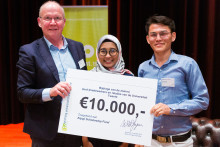
According to Meerburg, the idea for the fund came from a group of UT alumni and associates in 2016. They had seen a similar initiative at the University of Groningen. ‘They wanted to pool money to enable master’s students from developing countries to study at UT. With the knowledge they gain, they can contribute to rebuilding and developing their countries after completing their degree.’
Meerburg points out that the costs of studying in Europe for non-EU students can amount to 24,000 euros, which includes tuition fees, housing, and living expenses. For many, she says, that is prohibitively expensive. ‘In practice, UT can sometimes cover half of that amount through a UTS grant, but even then, twelve thousand euros is still a lot of money. Kipaji contributes the other half.’ The philosophy behind the fund is reflected in its name: the Swahili word Kipaji can mean both gift and talent.
Kabul’s public transport
Twelve students have now graduated thanks to the scholarship, Meerburg says. Interestingly, most of them still live in the Netherlands. One of them is Zakir Farahmand (34) from Afghanistan. ‘I came here as a municipal official from Kabul to pursue a master’s degree in transport. The idea was to use it to improve Kabul’s bus network.’
But things turned out differently. While Farahmand dreamed of modernising his city’s public transport system, the Taliban took control of the country and reversed many of the changes that had been made. As a result, Farahmand cannot simply ‘go home’, as he does not know how he would be received as a Western-educated academic. ‘My brother was recently arrested without any reason being given.’
Naturalised
The young researcher says the Kipaji fund has allowed him to take the next step in his career. He now works at UT as a PhD candidate in the Transport Planning research group at the ET faculty. With his income, he supports his family as best he can. Thanks to his support, his sisters are studying at a university in Iran. His parents still live in Afghanistan. ‘I haven’t seen them for eight years.’
It meant he had to put his vision for improved public transport in Kabul on hold. Farahmand has since become a naturalised Dutch citizen. ‘I don’t know how long the situation in Afghanistan will continue. Until then, I have to carry on in the Netherlands.’
Bus stops
Although he says he is happy here, he would ultimately still like to return. ‘I have a good life here, but it’s not what I came for. What I see here, the way the systems work, I want to make that possible for my people too. And I miss my family. Let’s say that the goal I came here with has become a wish.’
If that ever happens, five hundred bus stops that he helped design will still be waiting for him in Kabul.
For now, he will be at the lunch at the U Parkhotel on Friday, where scholarship recipients and donors will come together to share their stories and experiences.